
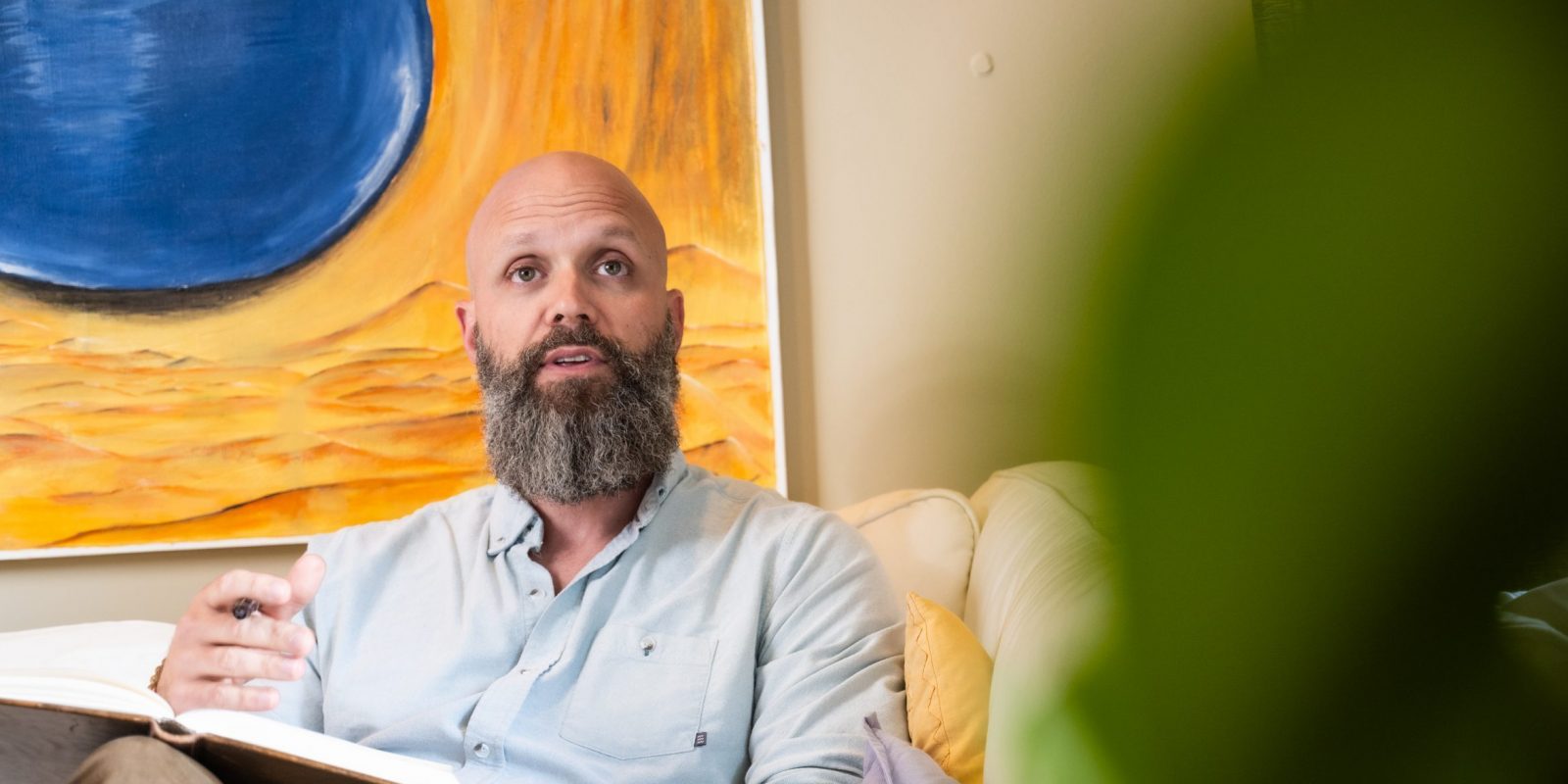
Before he became a psychotherapist, John Price was an up-and-coming musician in Fort Worth who embraced excess.
From Music to the Mind: TCU’s John Price on Jungian Psychology, Sobriety and the Sacred
The Houston therapist and podcast host on what rock ‘n’ roll, Jungian psychology and trust have in common.
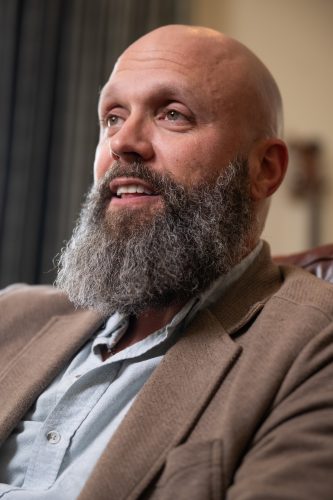
Price says his popular podcast, “The Sacred Speaks,” lets him play the devoted student, asking luminaries of spirituality and human development some of the most profound questions about the human experience.
Last fall, John Price ’01 (BS ’07) sat in his office with a 45-year-old psychotherapy client named Rick. A highly successful entrepreneur, Rick had started therapy six months earlier to address a growing suspicion that he’d focused on his career to the detriment of his family, just like his own father.
But now there was a crisis: Rick’s 18-year-old son had moved out of the house, saying as he left that his father wouldn’t even notice he was gone. The accusation had stung.
“I always told myself I wouldn’t turn out like my dad. I feel like such a failure,” said Rick, a composite of several of Price’s psychotherapy clients created to preserve anonymity for real people.
Price leaned forward. “We’re going to walk through this experience together. … My job is to encourage you to sit with those tough feelings and listen to what they might be teaching you. You’re going to be a better man on the other side of this.”
Rick sighed, and Price could see him relax, just a little.
A psychotherapist and co-founder of the Center for the Healing Arts and Sciences in Houston, Price is a sought-after retreat leader and host of the podcast The Sacred Speaks, in which he interviews luminaries of spirituality and human development including the Rev. Richard Rohr, Zen teacher Henry Shukman and writer Anne Lamott.
But before he earned his credentials, Price was an up-and-coming musician in Fort Worth who embraced excess. A quarter-life crisis, followed by a transformative experience in therapy, set him in a new direction.
“I have always been deeply spiritually oriented, and I did not have containers to really understand that until I discovered Buddhism and psychotherapy,” he said. “Psychotherapy was my first real spiritual container.”
The Wild Years
Price grew up in Houston in a largely traditional household, but he always possessed a streak of what he calls “the wild.” His real love was music, and from the time he began learning guitar at age 8, he envisioned a life on stage. He played in several bands in high school and worked at a coffee shop, where he wore a beret and smoked hand-rolled cigarettes.
A friend’s older brother who attended TCU invited him to a fraternity chili cookoff, and Price was sold: He enrolled at TCU and got involved in Greek life. By sophomore year, his eponymous Texas country band, whose sound Price describes as “Jack Ingram meets Reckless Kelly meets John Mayer,” was a higher priority than school. He became a fixture at Berry Street venue The Aardvark and opened for headliners including Pat Green.
After graduating — barely — with a degree in speech communication, he bartended while throwing himself into his music career with a wild lifestyle to match. The staff at Fort Worth Weekly recognized him for the “best rock star attitude.”
“I have always been deeply spiritually oriented, and I did not have containers to really understand that until I discovered Buddhism and psychotherapy.”
John Price
Price had signed with a record label and was heading out on tour when he learned that his then-girlfriend was pregnant. After his son was born, he said, he realized her personal struggles at the time made her incapable of parenting. The two battled for custody, and the court terminated his former girlfriend’s parental rights and awarded Price — a single man in his 20s — full custody.
As it dawned on him that he’d need to be the stable parent for a newborn, he came to grips with the end of his dream of being a rock star.
A Hard Conversation
Amid the custody fight, Price entered therapy with Sharlene Horak ’68. One day, he met up with friends at Joe T. Garcia’s around 11 a.m. — as he often did — to grab lunch and several drinks. That afternoon, he went to an appointment with Horak.
As he sat down, Horak sniffed. “John, have you been drinking?”
“Yeah, it’s been a great day!” he began.
Horak stopped him. “This is problematic behavior,” she told him. “You’re in the middle of a custody case. This is a big deal.”
He and Horak had developed a strong therapeutic relationship, and he trusted her.
“OK,” he said, after a pause. “What do you think I should do?”
Horak’s recommendation was to try 90 days of sobriety. Price agreed, and three months turned into five years. He also dropped caffeine, took up yoga and began a meditation practice. The lifestyle changes helped him become a better father, but he was still searching for a new career path.
One day, he told Horak that he was intrigued by her profession. “Then give it a shot,” she told him.
“He had a very deep essence and a reverence and a spirituality already,” Horak said. “He liked what he was doing [in therapy], even though it was painful. He was so good at it, and I knew that he would be good in whatever direction of the healing arts that he went into.”
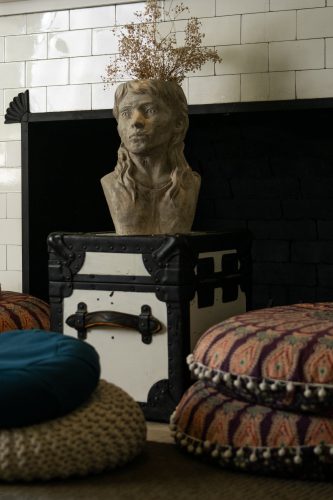
A planter decorates a common room at the Center for the Healing Arts and Sciences in Houston.
Finding the Work
Price re-enrolled at TCU to study psychology, learning from Karyn Purvis ’97 (MS ’01, PhD ’03), co-founder of the Institute of Child Development. “I’ve never met a professor who blended together more dynamics: neuroscience, philosophy, religion, spirituality, clinical work, relational work, intuition — she had it all,” Price said.
He earned a master’s in clinical psychology from the University of Houston – Clear Lake in 2009 and worked at an adolescent treatment center before opening his private practice. When his son was 4, he met Leila-Scott Mitchell, a licensed acupuncturist and practitioner of traditional Chinese medicine. They married two years later and had a daughter. In 2014, the couple opened the Center for the Healing Arts and Sciences, a wellness center in Houston offering services including yoga, acupuncture, Chinese medicine, Jungian analysis and psychotherapy.
“It felt very important to provide a space where people could come be understood, seen and worked with in a whole-person way, so that their mind, body and spirit could all be addressed in one place,” said Leila-Scott Price, who serves as the center’s CEO.
The Jungian Turn
Price earned a doctorate in Jungian psychology through a partnership between Saybrook University and the Jung Center of Houston. He said the therapeutic approach of the Swiss psychiatrist Carl Jung, who lived from 1875 to 1961, appealed to him because it focuses more on the imagination and consciousness than on problem-solving or pathologizing.
A key element is individuation, what Price calls a spiritual process of becoming oneself fully. Clients on this path unpack the messages they received early in life from family, religion and wider society about who they should be and work to create a more authentic self.
Jung was also interested in ecstatic experience, transcendent states induced by beauty, awe, sex, nature, crisis, trauma and psychedelics. Recalling his own search for altered states of consciousness in more destructive contexts, Price was intrigued by Jung’s inquiry into spiritual and mystical experiences that lead to greater self-understanding.
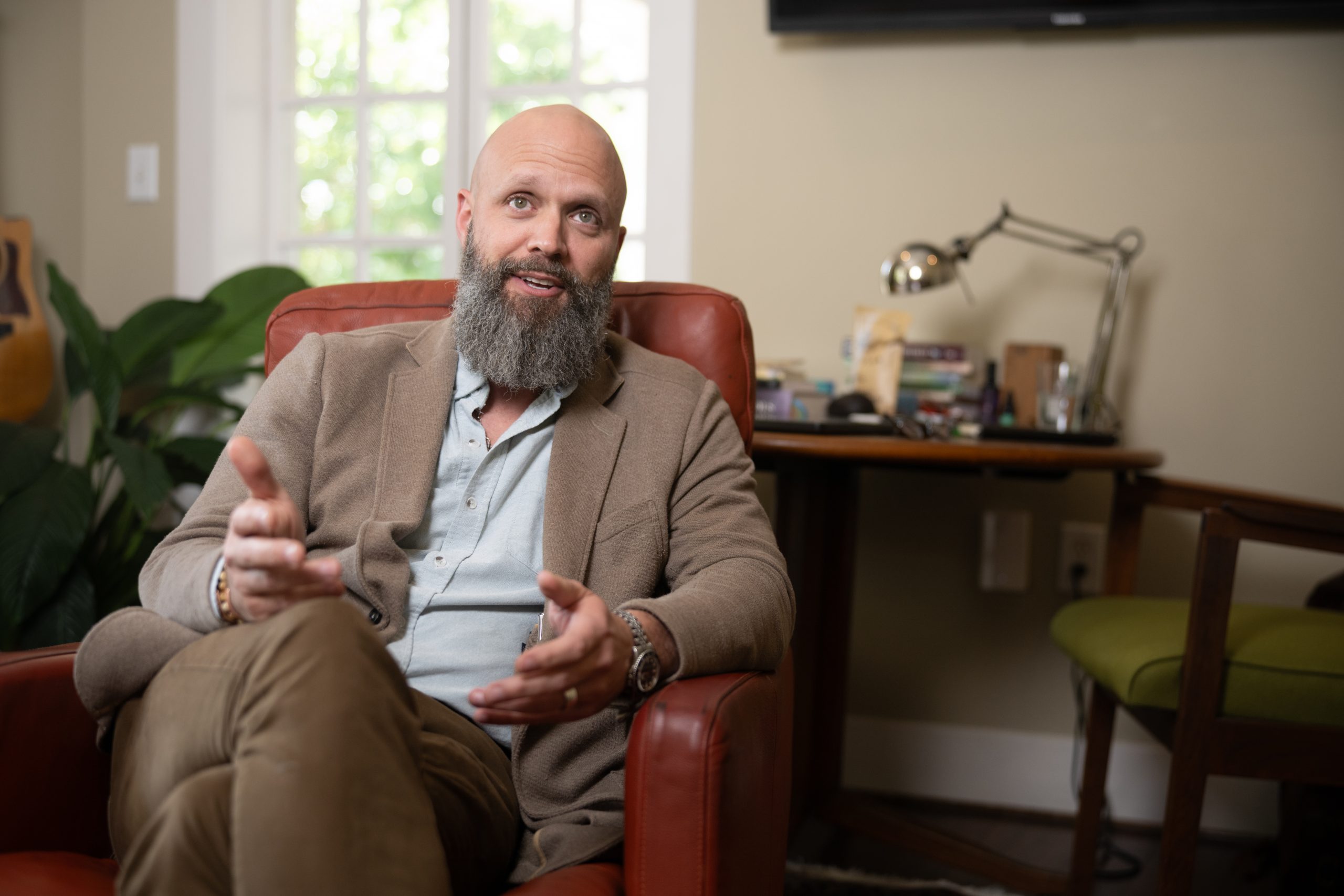
Price was drawn to Carl Jung’s approach because it focuses more on the imagination and consciousness than on problem-solving or pathologizing.
Psychedelics, Price said, can facilitate such realizations by helping users access insights stored in the unconscious. “When people have these really powerful experiences, they have transformational memories,” said Price, who cautioned that such practices should only be attempted with an experienced guide. Psychedelic research in the United States is accelerating, given a federal boost by an April executive order directing agencies to prioritize research, expand clinical trial participation and establish a pathway for qualifying investigational therapies. Many leading psychedelic compounds remain illegal at the federal level, however, and access remains restricted.
Price does not guide clients through psychedelic experiences; his role is helping people integrate their related insights into daily life.
He has led workshops about this integration at the Esalen Institute, a holistic retreat center founded in 1962 in Big Sur, California. The institute is a locus for the human potential movement, which emerged from the 1960s counterculture and has sought to expand people’s capacity for creativity, fulfillment and connection.
The Sacred Speaks
Integration is a frequent topic on Price’s podcast, The Sacred Speaks. His conversations with scholars, theologians and therapists focus on spirituality, mysticism, creativity and human development. Its 140 episodes have been downloaded more than 1 million times and include “Ordinary Mysticism: Your Life as Sacred Ground” with Mirabai Starr; “Religion, Medicine, Science & the Brotherhood of the Screaming Abyss” with Dennis McKenna; and “The Alchemy of Your Dreams: A Guide to the Art of Lucid Dreaming and Interpretation” with Athena Laz.
Price said the podcast has given him the opportunity to “present for people a process of a devoted student sitting at the feet of masters and asking some of the most powerful and profound questions.”
Jeffrey Kripal, the J. Newton Rayzor Chair in Philosophy and Religious Thought at Rice University, has been a guest several times.
Through the podcast, Kripal said, Price invites listeners to consider aspects of the human experience that haven’t been explained by religion or science, including the meaning of dreams and insights from ecstatic experiences.
“I think people are desperate to have that conversation,” Kripal said. “There’s a kind of hopeful tenor or message here that is very countercultural at the moment.”
In It With You
Price also leads an online community that explores emotions that he said most people were taught to repress rather than interrogate: jealousy, shame, anger, anxiety. He is at work on a book about the stages of the spiritual psychotherapeutic process and a documentary with Catholic priest and writer Richard Rohr. He leads a group called Odyssey for men like Rick who have achieved professional success but lack a relationship with their inner life.
Colleague Rodney Waters, a Jungian analyst, describes Price as successfully channeling aspects of his younger wildness into his therapeutic work.
“In this rock ’n’ roll, drug-fueled craziness of his 20s was a real attraction to darkness,” Waters said. “His ability to work with people in really, really dire situations is a beautiful image of the transformation of this desire to move toward the dark underbelly of life that rock ’n’ roll often represents — and to do the same thing in a beautifully spiritual way.”
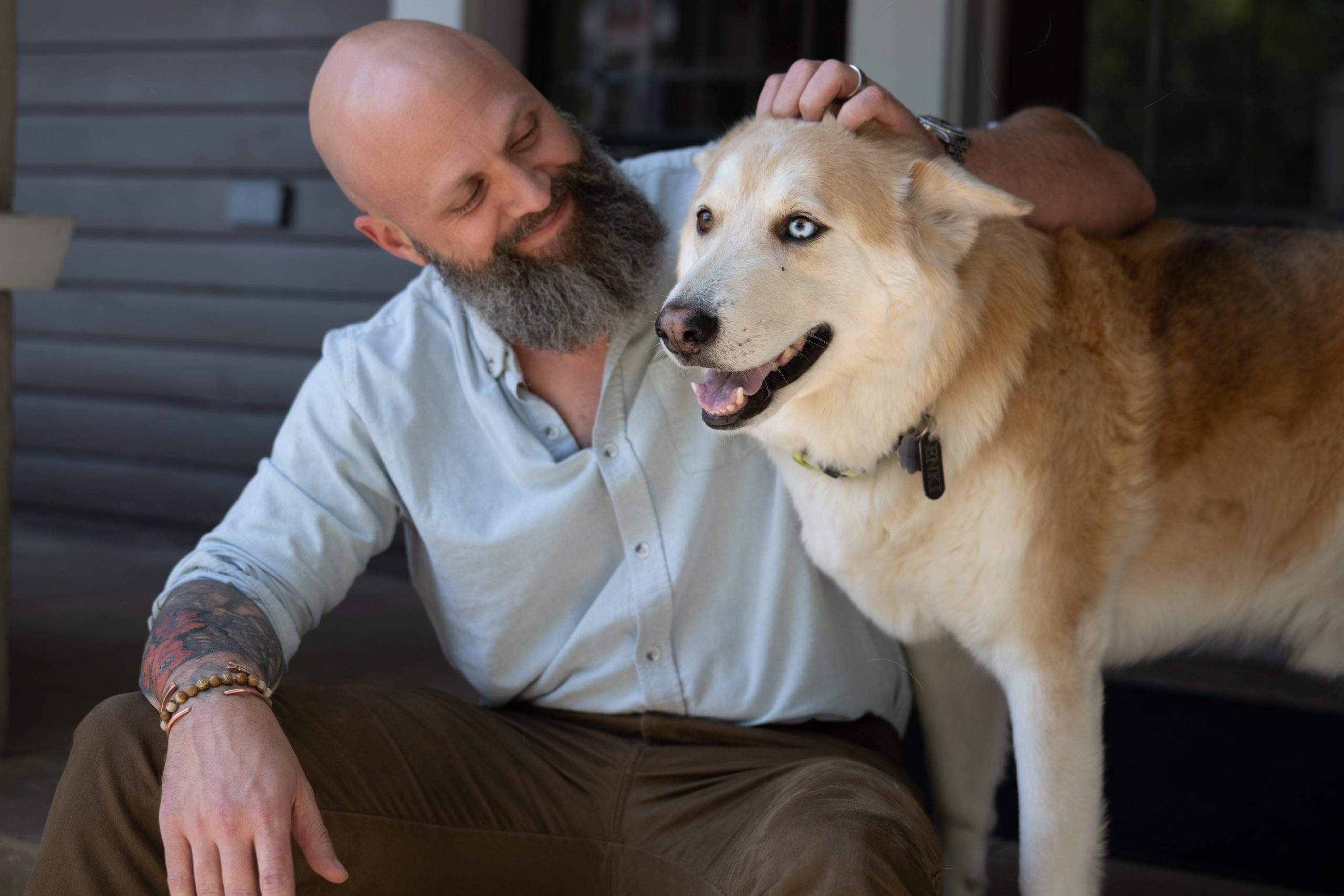
Price with his dog, Enki, at the Center for the Healing Arts and Sciences in Houston, which he and his wife, Leila-Scott Price, opened in 2014.
Price said his “main medicine” is the relationship he builds with clients. Feeling that safety, clients develop the courage to reveal vulnerable truths: I feel meaningless, or I fear my own capacity for violence. Price sees his job as taking those revelations in stride, responding with compassion and acceptance.
“One of my gifts is that I have the ability to bypass people’s defense mechanisms,” he said. “I never learned that in psychotherapy school. However, I learned that with Karyn Purvis: that one of the first things I do is build trust. I think people really like that I’m a wounded healer, that I’m in it with you.”
Your comments are welcome
Comments
Related reading:
Features
Guitar Hero
With gospel roots and rock star energy, Mark Lettieri is instrumental to Snarky Puppy’s success.
Research + Discovery
Life on the Fringe
In an award-winning podcast, Tricia Jenkins talks about being raised in a cult.
Alumni, Features
Sue Monk Kidd Found the Courage to Pursue her Passion
The Book of Longings is the bestselling author’s latest novel.