
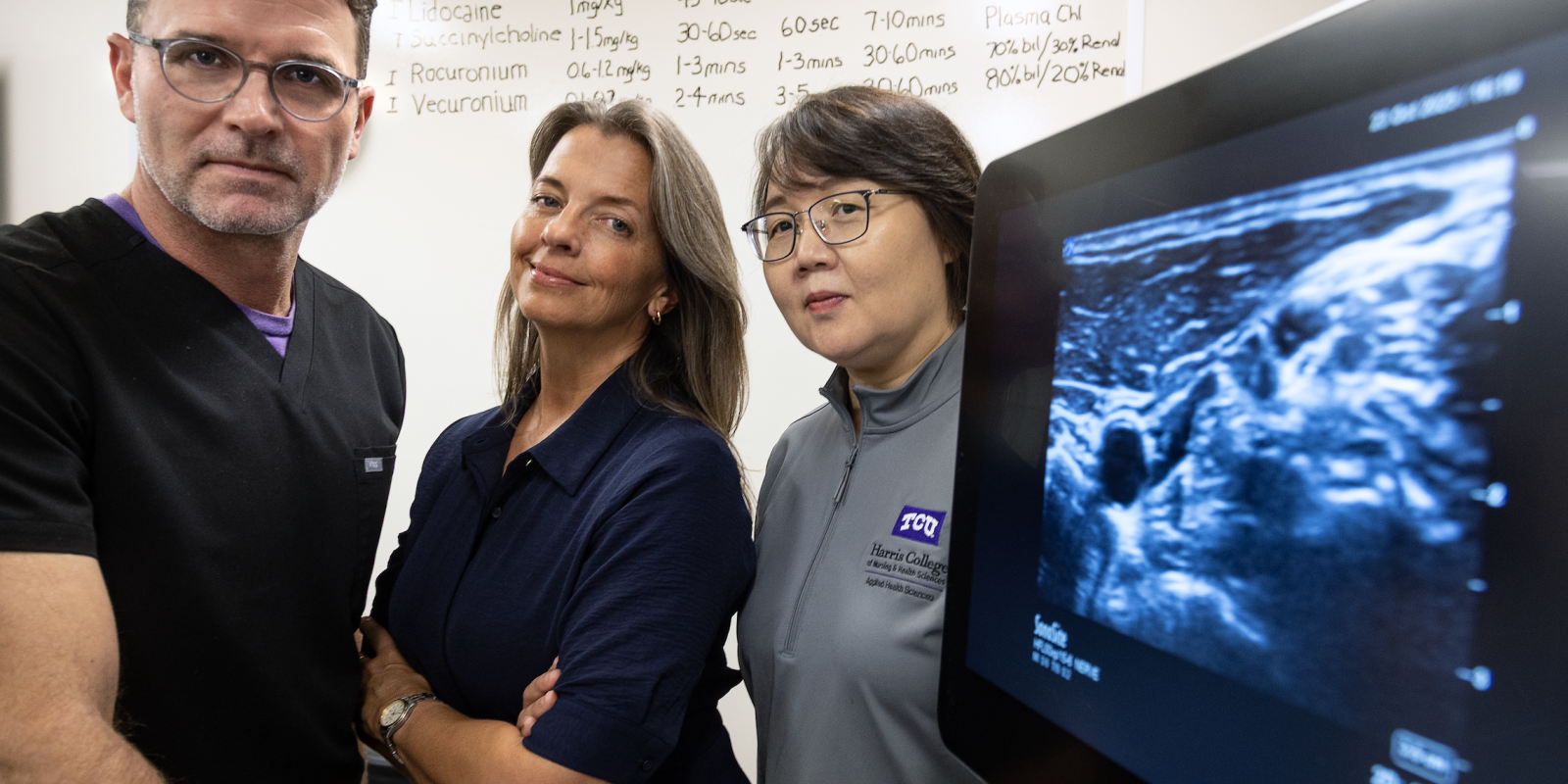
Gregory Collins, Vaughna Galvin and Yan Zhang of TCU's Harris College of Nursing & Health Sciences were part of a publication team that helped bring results of a promising long Covid treatment to the world. Photo by Ralph Lauer
TCU-Trained Nurse Anesthetist Offers Treatment for Long Covid-Induced Loss of Smell
Stellate ganglion blocks — numbing injections into neck nerves — restored smell and taste for 75 percent of long Covid patients. Harris College researchers published the results to global acclaim.
At her mother’s funeral in July 2020, Jennifer Knight caught Covid-19. She recovered, but for six months, the pediatric nurse practitioner was unable to taste or smell. After both senses began to return, she found that almost everything smelled and tasted terrible.
Her husband “couldn’t make coffee in the house,” Knight said. “I couldn’t even be around somebody that had coffee.”
It wasn’t just coffee. Almost everything smelled the same, like “roadkill around a paper mill.”
After months of suffering, Knight decided to pursue an unusual treatment offered by David Gaskin, a TCU-trained nurse anesthetist.

Dennis Cheek, Abell-Hanger Professor of Gerontological Nursing, led the TCU Harris College team that helped publish David Gaskin’s long Covid treatment research, bringing academic rigor to clinical innovation. Photo by Ralph Lauer
Gaskin would go on to partner with four faculty members from TCU’s Harris College of Nursing & Health Sciences to publish a study on his innovative long Covid treatment, which appears to help restore malfunctioning senses.
“We are very unique in the School of Nursing,” said Dennis Cheek, Abell-Hanger Professor of Gerontological Nursing, who steered the team through publication. “We have a lab.”
The department also has a statistician, Yan Zhang, a professor of professional practice in applied health. She joined the research team to analyze data from 195 people whom Gaskin treated for long Covid-related smell disorders.
The combination of institutional resources and practitioner savvy has brought the results to readers around the world.
‘AN AWFUL, DARK TIME’
Knight was one of many flocking to Gaskin’s clinic for relief from taste and smell problems. Arriving from as far away as South Africa and Israel, Gaskin said, these patients are living with miserable symptoms. Some, unable to eat, require stomach tubes.
For Knight, these sensory distortions caused “an awful, dark time. … Basically, for a year and a half, my life stopped.”
Knight survived on cold macaroni and cheese and a few other safe foods and had to avoid a family Thanksgiving. She lost friendships. “It’s a very lonely, silent disorder. … People have ended their lives over this illness,” she said.
After hitting her rock bottom — having to skip a food-oriented church retreat — Knight and her husband drove from their home in Florida to Gaskin’s clinic in Bryan, Texas. There, she underwent two injections into the neck called stellate ganglion blocks.
Within minutes, Knight’s senses of taste and smell drastically improved. She was stunned and elated. In the years since, despite two more Covid bouts, the problems have not returned.
A NERVOUS SYSTEM REBOOT?

Jennifer Knight lost her sense of smell and taste for six months, then suffered distorted senses for another year. Stellate ganglion blocks brought 90-95 percent improvement almost instantly. Photo courtesy of Jennifer Knight
Long Covid can affect many parts of the body, leading to symptoms that include severe fatigue, brain fog and abnormal heart rate as well as sensory disorders. A dysregulated interplay between the nervous system and the inflammatory response may be involved.
The stellate ganglion is a bundle of nerves in the neck, one on each side of the voice box. It is a way station of the sympathetic nervous system that routes fight-or-flight impulses between the brain and body. For people who have lost the ability to taste and smell normally due to long Covid, pausing that nerve traffic for a few minutes with an injection of numbing medication — a stellate ganglion block — may bring immediate, lasting relief.
After reading a journal article by a doctor who reported success treating two long Covid patients with the technique, Gaskin offered in late 2021 to treat a fellow nurse anesthetist who had long Covid. It worked, he said, which encouraged him to offer it to others.
Knight learned about the treatment possibility from a Facebook group for parosmia (smell disorder) sufferers that had tens of thousands of members.
Gaskin explained that stellate ganglion blocks have long been used for a variety of pain and blood vessel disorders. It may help with ailments including autoimmune disease, fibromyalgia, inflammatory bowel disease and post-traumatic stress disorder. The procedure may be “resetting our autonomic system, bringing it back into balance,” as he put it — a reboot that might somehow also be nudging distorted senses of taste and smell back toward normalcy.
Guided by ultrasound, Gaskin gave Knight an injection of lidocaine into each side of her neck near the ganglia, a few hours apart. After the first injection, Knight warily sniffed Doritos and a peanut butter cup. She could tolerate them, and the smell of coffee, too.
“I was crying,” she said. “It was crazy, the emotion.”
After the second injection, Knight estimated, she was 90 percent to 95 percent better. She ate Doritos. She whooped for joy. “I literally went out and laid in the grass to smell the grass,” she said. “I’d gotten my life back.”
ACADEMIC RIGOR, GLOBAL REACH
Gaskin has stayed connected to TCU, teaching nurse anesthesia residents about pain management techniques. Along with Cheek and Zhang, the team that readied his work for publication included Vaughna Galvin, associate professor of professional practice, and Gregory Collins, assistant professor of clinical practice.
While academic institutions often document results gathered by a community-based clinician, Galvin said, “Having a veteran first author like Dennis Cheek speeds the process.”
The team also worked with TCU’s Institutional Review Board, which ensured appropriate protection of patient data. TCU library resources helped them navigate open-access publication, an increasingly popular alternative to traditional subscription-based publishing, in which authors pay a fee in exchange for free access for readers.
The paper, published in May 2023 in the open-access journal Local and Regional Anesthesia, demonstrated how Gaskin injected the stellate ganglion blocks.
Following the procedure, three-fourths of patients reported improved senses of smell and taste. As of November 2025, the article had garnered nearly 12,000 views and generated multiple requests for speaking engagements and additional articles.
“This project shows the value of clinicians and academics working together,” Zhang said.
Gaskin is now working on a second paper that reports improvements in 14 additional long Covid symptoms.
“I do believe that more clinicians should be eager to have their outcomes evaluated. … This should always guide our treatment plans,” Gaskin said. “If we are doing a good job of tracking our outcomes, then why would we not want to publish that data for others to see?”
One team member saw the results up close. “He did a stellate ganglion [block] on my son, who had lost his sense of smell completely,” Galvin said. “A teenage boy could suddenly smell his own socks.”
Word spread quickly. At a 2024 conference in France, a physician from Romania approached Gaskin, telling him a patient had brought him a copy of the article and requested the same treatment.
“He read the publication,” Gaskin said. “He brought her back and performed the [procedure] as I detailed in the paper, and she obtained excellent results.”
Your comments are welcome
2 Comments
I would like to participate. I have had COVID twice and 3 sinus surgeries. Would I be a good candidate for this treatment?
Am I a viable candidate for this treatment? I lost 100% of my senses of smell and taste about 7 years ago (with no Covid beforehand or during). No brain damage detected via x-rays and no signs of Parkinson’s. I’m a 79 YOM. I’m seeing an ENT doctor for advice soon, but looking for any extra information beforehand. Thank you.
Related reading:
Research + Discovery
How TCU Scientists Are Stopping the Body From Harming Itself
TCU researchers are on the trail of treatments for deadly fungal infections, Parkinson’s and more.
Research + Discovery
Startup Speed, Academic Soul
Reuben F. Burch V is crafting a research culture at TCU that moves fast, stays student-centered and delivers real-world impact.